GEOTECHNICAL ENGINEERING
IRVING
HomeIn-Situ TestingField density test (sand cone method)

Field Density Testing in Irving, Texas: The Sand Cone Reality

Site investigations you can build on.

LEARN MORE

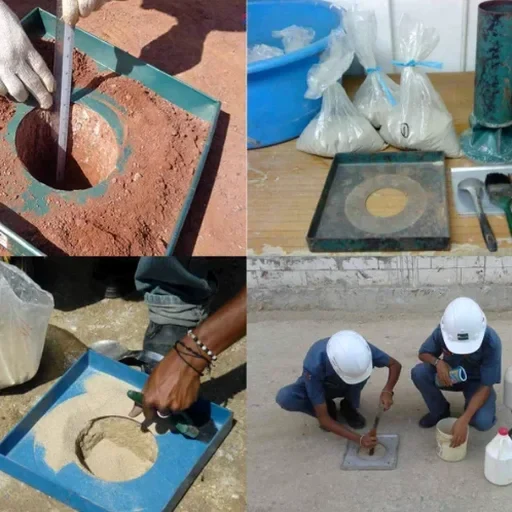
A superintendent on an Irving distribution center project watches a scraper fleet compact 14 feet of fill. The spec calls for 98% modified Proctor density in every lift. Without an accurate in-place density reading, the next lift doesn’t happen. That’s where the sand cone test, run per ASTM D1556, becomes non-negotiable. It’s not the fastest method, but on the clayey sands common across the DFW metroplex—Irving included—it delivers a direct, defensible number. Our field crew works alongside your grading contractor, cutting density holes at the frequency the geotechnical report demands, and weighing the sand on a calibrated scale right there on the pad. When foundation subcontractors need to reconcile a plate load test result with what the proof roll is actually telling them, the sand cone data bridges the gap without ambiguity.

A sand cone test on Irving clay fill gives you the one number the inspector can’t argue with: pounds per cubic foot, dry, right off the truck scale.
Our service areas

Process and scope

The Eagle Ford Shale in this part of Dallas County weathers into a fat clay that swells hard after rain and shrinks during the 100-degree August stretches Irving gets every summer. That cycle punishes poorly compacted fill. The sand cone test measures total density and, paired with a lab moisture content, gives the dry density that the spec’s acceptance curve is based on. Hole depth is typically the full lift thickness—most often 8 to 12 inches—and the test takes about 20 minutes per location once the technician is set up. On projects where the structural engineer has called out proof of bearing in the upper fill zone, we’ll correlate sand cone results with in-situ permeability data when drainage through the compacted layer is a design parameter. The sand volume in the apparatus is calibrated daily against the same Ottawa sand lot, and the cone correction factor is rechecked on every job before the first hole is poured.
Field Density Testing in Irving, Texas: The Sand Cone Reality
Technical reference — Irving

Site-specific factors

The common mistake on Irving commercial pads is running density tests only on the top lift of a multi-lift fill. A 6-foot engineered fill section may have 8 lifts, and if lift 4 was compacted at 4 percent over optimum moisture because a water truck broke down, that layer becomes a perched settlement plane. Two years after the TCO is signed, the tilt-wall panels start pulling away at the joints. The sand cone method, applied at the right frequency through the full fill depth, catches that soft layer before the next lift buries it. Another error: using a nuclear gauge without sand cone correlation on soils with variable iron content—the Eagle Ford has enough hematite nodules to throw off a nuclear reading by several percentage points. We’ve seen a gauge report 102 percent compaction on material that the sand cone later proved was at 88 percent. When the City of Irving inspector asks for the backup density log, a sand cone report with time-stamped locations and signed field sheets is what closes out the earthwork phase without a stop-work order.

Need a geotechnical assessment?

Reply within 24h.

Email: [email protected]

Reference standards

ASTM D1556: Standard Test Method for Density and Unit Weight of Soil in Place by Sand-Cone Method, AASHTO T 191: Density of Soil In-Place by the Sand-Cone Method, ASTM D698 / D1557: Standard Test Methods for Laboratory Compaction Characteristics (Proctor), ASTM D2216: Standard Test Methods for Laboratory Determination of Water (Moisture) Content, IBC 2018 Chapter 17: Special Inspections and Tests (earthwork acceptance criteria)

Technical parameters

ParameterTypical value
Applicable standardASTM D1556 / AASHTO T 191
Test depth rangeUp to 12 inches per lift (typical)
Calibration sandGraded Ottawa sand (bulk density calibrated daily)
Minimum hole volumeVolume equivalent to max particle size x 4
Field moisture sampleSealed can; lab oven-dried per ASTM D2216
Reporting metricDry density (pcf) and percent compaction vs. Proctor
Frequency guidanceOne test per 2,500 sq ft per lift (IBC 2018 Chapter 17)

Common questions

How many sand cone density tests does the City of Irving typically require on a commercial building pad?

The International Building Code (IBC 2018), which Irving has adopted, references a frequency of one field density test per 2,500 square feet per lift. On a 50,000-square-foot pad with 8-inch lifts, that works out to about 20 tests per lift. The geotechnical engineer’s report may tighten that frequency in areas with marginal subgrade.

What does a field density test using the sand cone method cost on an Irving project?

For budgeting purposes, a single sand cone density test in the Irving area typically runs between US$90 and US$150, depending on how many tests are performed in a day and whether the moisture sample is processed in the field or back at the lab. Mobilization is usually a separate line item.

Can the sand cone test be used in coarse gravel or crushed concrete fill?

ASTM D1556 states that the method is best suited for soils with a maximum particle size of about 1.5 inches. In clean gravel or recycled concrete with larger particles, the hole walls tend to collapse or the gradation is too coarse for the sand to flow uniformly. For those materials, we recommend a large-scale water replacement method or a test pit with a direct volume measurement.

How soon after compaction can the density test be performed?

Immediately. There is no waiting period. Once the roller has made its final pass and the lift is trimmed, the technician can cut the hole and run the test. The only constraint is that the moisture sample must be sealed quickly in the Irving summer heat to avoid losing water before the lab weighing.

Location and service area

We serve projects in Irving and surrounding areas.

View larger map