GEOTECHNICAL ENGINEERING
IRVING
HomeInvestigationExploratory test pit

Exploratory Test Pit Services in Irving, Texas

Site investigations you can build on.

LEARN MORE

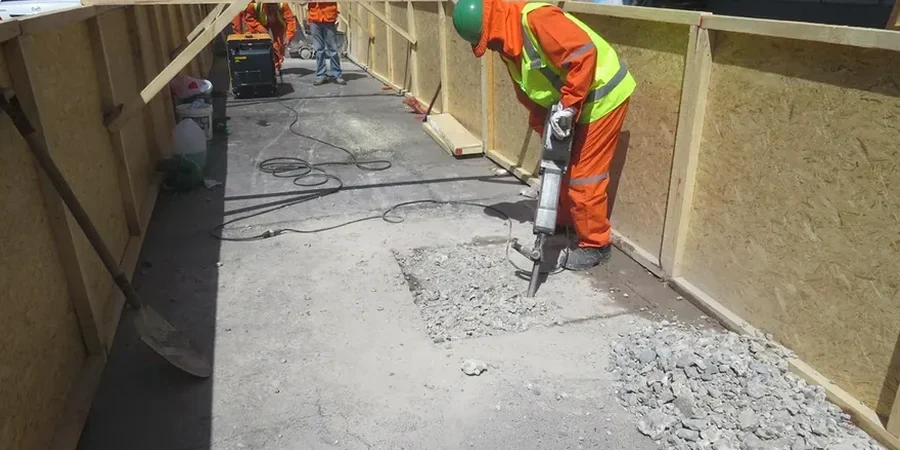
When you're building on the expansive clay formations that run through the Trinity River corridor, surface clues rarely tell the full story. In Irving, we keep seeing projects where the design team assumed uniform stiff clay only to find sand lenses or moisture-sensitive layers three feet down. An exploratory test pit lets you walk the excavation, photograph the strata, and collect undisturbed samples before your foundation contractor commits to a number. Our crew handles the backhoe coordination, OSHA-compliant shoring, and ASTM D2487 logging so you get a defensible geotechnical record that the City of Irving plan reviewer will accept without pushback. For deeper bearing evaluation beyond eight feet, we often pair the pit program with SPT drilling to capture blow counts where trench safety becomes impractical.

An open excavation remains the most direct method to map desiccation cracks, jointing, and perched water that boreholes often miss.
Our service areas

Process and scope

A recent warehouse expansion near the DFW airport interchange showed why pits matter here. The initial geophysics suggested uniform Eagle Ford Shale, but when we opened a 10-foot exploratory test pit at the north corner, the wall exposed a thin bentonite seam that would have caused differential heave under slab-on-grade loading. We logged the discontinuity, sampled the material for Atterberg limits, and adjusted the moisture-conditioning specification before the pad was certified. Key technical capabilities we bring to every Irving project include:
  • ASTM D2488 visual-manual classification supplemented by lab index testing
  • Bulk and thin-wall tube sampling at discrete horizons for strength and consolidation analysis
  • Pocket penetrometer and field vane shear testing performed directly on exposed benches
  • Groundwater observation and seepage mapping during open-pit conditions
Exploratory Test Pit Services in Irving, Texas
Technical reference — Irving

Site-specific factors

Soil conditions shift noticeably between the older Las Colinas terraces and the lower-lying floodplain tracts south of Highway 183. In Las Colinas, we typically encounter weathered shale with occasional calcareous nodules that can mislead pocket penetrometer readings if you don't clean the face properly. Down near the Elm Fork branches, alluvial silts and loose sands dominate, and an unshored exploratory test pit can slough within minutes after rain. Skipping a pit investigation in these areas risks assuming uniform bearing where none exists, which translates into slab cracking, utility trench settlement, or retaining wall distress within the first two wet-dry cycles. The IBC requires a geotechnical investigation for all structures, and the City of Irving enforces that requirement during permit review.

Need a geotechnical assessment?

Reply within 24h.

Email: [email protected]

Reference standards

ASTM D2488: Standard Practice for Description and Identification of Soils (Visual-Manual Procedure), ASTM D2487: Standard Practice for Classification of Soils for Engineering Purposes (Unified Soil Classification System), IBC 2021: International Building Code, Chapter 18 – Soils and Foundations, OSHA 1926 Subpart P: Excavations and Trenching Safety Requirements

Technical parameters

ParameterTypical value
Maximum practical depth12–14 ft with standard backhoe; deeper with benching
Typical pit width24–36 inches for narrow trenches; wider for stepped access
Sampling methodBlock, thin-wall tube, and bulk bag per ASTM D4220
Logging standardASTM D2488 / D2487 (USCS classification)
Shoring requirementOSHA 1926 Subpart P for excavations deeper than 5 ft
Groundwater detectionFree water and seepage zones mapped during exposure
Reporting deliverablesGraphic log, photo panel, lab test summary, bearing recommendations

Common questions

How much does an exploratory test pit cost in Irving, TX?

For sites within Irving, typical pricing ranges from US$460 for a single shallow pit with basic logging to around US$810 when the scope includes multiple sample depths, lab testing, and a detailed geotechnical report. Final cost depends on access constraints, depth required, and whether traffic control or shoring is needed.

How long does the City of Irving take to approve a geotechnical report with test pit data?

If the exploratory test pit log, lab results, and bearing recommendations are complete and follow IBC Chapter 18 format, Irving's building department typically reviews the geotechnical package within one to two permit review cycles. Incomplete classification data or missing groundwater observations are the most common reasons for resubmission.

Can you perform exploratory test pits near existing structures or utilities?

Yes. We call in a Texas811 locate ticket at least two business days before excavation and hand-expose any utility within five feet of the pit boundary. For pits adjacent to footings or retaining walls, we evaluate the zone of influence and may reduce depth or use spot benching to avoid undermining.

Location and service area

We serve projects in Irving and surrounding areas.

View larger map