GEOTECHNICAL ENGINEERING
IRVING
HomeInvestigationCPT (Cone Penetration Test)

CPT (Cone Penetration Test) Investigations in Irving, Texas

Site investigations you can build on.

LEARN MORE

The geology beneath Irving tells a story of ancient seas and shifting rivers. Much of the city sits on the Eagle Ford Shale and Woodbine Sandstone formations, capped by Pleistocene terraces and floodplain alluvium along the Trinity River tributaries. The expansive clay soils here—particularly the Smectite-rich Eagle Ford—can swell up to 10% in volume when saturated, a condition that wreaks havoc on shallow footings. For geotechnical engineers working across Las Colinas or the Heritage District, the cone penetration test provides a continuous stratigraphic profile that captures these transitions between stiff clay and weathered sandstone. Unlike traditional borings that recover disturbed samples every few feet, CPT data reveals thin sand lenses and fissures that could channel water beneath a slab. In Irving's commercial corridors, where high-rise construction has accelerated near the Urban Center, the need for precise subsurface characterization has never been greater.

Continuous CPT profiling captures thin sand lenses and perched water tables in Irving's Pleistocene terraces that conventional borings routinely miss.
Our service areas

Process and scope

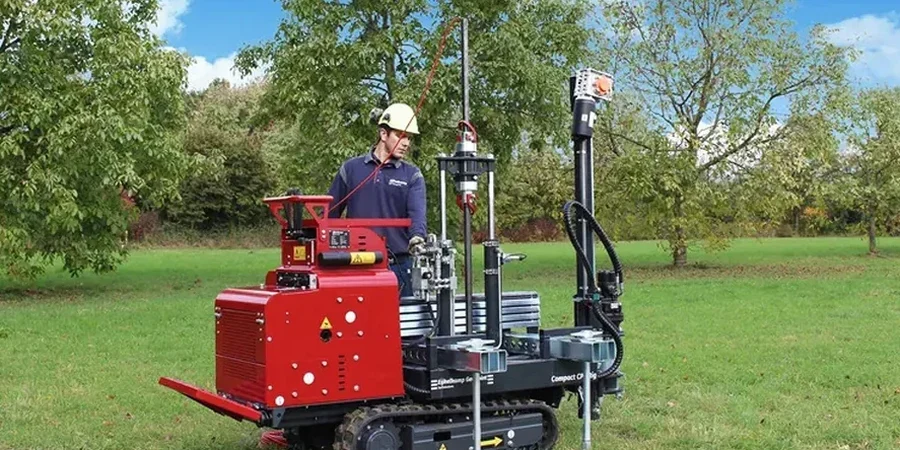
In Irving, many times we see that the transition zone between the Austin Chalk formation and the overlying alluvial deposits creates a bearing stratum that is highly variable within a single site. A standard SPT boring might hit refusal on a limestone nodule at 12 feet and misclassify the entire layer as rock, when in reality the nodule is floating in a softer clay matrix. The CPT overcomes this by measuring tip resistance and sleeve friction every two centimeters. This resolution becomes critical when designing mat foundations for tilt-wall warehouses in the DFW industrial parks, where differential settlement tolerances are tight. We also encounter perched groundwater tables in the sandy lenses of the Pleistocene terraces—a condition that can go undetected during dry-season drilling. For projects near the Elm Fork of the Trinity River, combining CPT data with liquefaction analysis is standard practice under IBC Chapter 18, given the loose silty sands mapped in FEMA flood zones. The cone's piezocone sensor further allows us to estimate in-situ permeability, a parameter that drainage designs rely on for the city's detention pond requirements.
CPT (Cone Penetration Test) Investigations in Irving, Texas
Technical reference — Irving

Site-specific factors

IBC Section 1803.2 mandates that foundation investigations account for soil's expansion potential, a requirement that carries particular weight in Irving. The Eagle Ford Shale's classification as a CH soil—with liquid limits frequently exceeding 50—places it in the high to very high expansion category per ASTM D4829. Developers who skip the CPT and rely solely on SPT blow counts often underestimate the depth of the active zone where seasonal moisture fluctuation occurs; in Irving, this zone can extend to 15 feet below grade. The consequence is slab heave that lifts interior partition walls and cracks post-tensioned cables. A secondary risk involves paleochannels—buried, sand-filled river channels from the Pleistocene—that create abrupt lateral changes in bearing capacity. A CPT transect across a site can map these channel boundaries with precision. For deep excavations near the Urban Center light rail alignment, the cone's continuous pore pressure data also helps predict base instability before it becomes a safety incident during construction.

Need a geotechnical assessment?

Reply within 24h.

Email: [email protected]

Reference standards

ASTM D5778-20 Standard Test Method for Electronic Friction Cone and Piezocone Penetration Testing of Soils, IBC 2024 Chapter 18 — Soils and Foundations (adopted by City of Irving with local amendments), ASCE 7-22 Minimum Design Loads and Associated Criteria for Buildings and Other Structures, ASTM D2487-17 Standard Practice for Classification of Soils for Engineering Purposes (Unified Soil Classification System), ASTM D6066-11 Standard Practice for Determining the Normalized Penetration Resistance of Sands for Evaluation of Liquefaction Potential

Technical parameters

ParameterTypical value
Maximum penetration depthUp to 100 ft (dependent on soil resistance and rig capacity)
Data acquisition interval2 cm (standard) — continuous digital profile
Measured parametersCone tip resistance (qc), Sleeve friction (fs), Pore pressure (u2)
Friction ratio calculationRf = (fs / qc) × 100% — soil behavior type classification
Pore pressure dissipation testst50 time to 50% consolidation — estimates coefficient of consolidation
Applicable standardASTM D5778-20 for electronic friction cone and piezocone testing
Typical cone capacity60-ton thrust system for Irving's stiff clays and shale refusal

Common questions

What is the typical cost for a CPT sounding in Irving?

For Irving and the broader Dallas County area, a standard CPT sounding typically ranges from US$180 to US$230 per linear meter, depending on depth, mobilization logistics, and whether piezocone or seismic modules are required. A minimum mobilization fee usually applies for single-sounding projects.

How deep can the CPT rig penetrate in Irving's shale formations?

In our experience across Irving, the 60-ton rig typically reaches refusal between 40 and 70 feet in the weathered Eagle Ford Shale, though penetration depth varies significantly. Where the Woodbine Sandstone is encountered at shallower depths—common in the northern part of the city near the Airport Freeway corridor—refusal may occur at 25 to 35 feet.

Does the CPT replace the need for soil borings entirely?

The CPT provides continuous in-situ data but does not recover physical soil samples. For projects requiring laboratory classification tests—such as Atterberg limits or triaxial shear strength—we often pair CPT soundings with one or two targeted borings at key locations. The CPT then helps interpolate conditions between these calibration points.

Can the CPT identify the expansive clay layers that cause foundation problems in Irving?

Yes. The friction ratio derived from CPT data, combined with the pore pressure response during dissipation tests, provides a reliable indicator of fine-grained, high-plasticity soils. When we see low tip resistance paired with elevated sleeve friction and slow pore pressure decay, that signature aligns with the expansive Eagle Ford clays responsible for slab heave in Irving neighborhoods.

How long does a typical CPT investigation take on an Irving site?

A single CPT sounding to 60 feet depth, including setup and pore pressure dissipation tests at selected intervals, generally requires 2 to 3 hours. A full-day investigation with our crew can complete 3 to 5 soundings across a commercial site, depending on access conditions and traffic coordination in developed areas like Las Colinas.

Location and service area

We serve projects in Irving and surrounding areas. More info.

View larger map