GEOTECHNICAL ENGINEERING
IRVING
HomeGeophysicsElectrical resistivity / VES (Vertical Electrical Sounding)

Electrical Resistivity Testing (VES) for Site Investigation in Irving

Site investigations you can build on.

LEARN MORE

Irving sits at 482 feet above sea level on the Eastern Cross Timbers ecotone, where expansive Eagle Ford Shale meets Trinity Group sands. That contact zone creates abrupt resistivity contrasts that standard drilling alone can misinterpret. Our team runs VES surveys across Las Colinas, Valley Ranch, and the Heritage District to map these transitions before a single borehole is drilled. We use the Schlumberger array with AB/2 spacings out to 300 feet, pulling apparent resistivity curves that distinguish saturated clay from dry sand without disturbing the formation. For deeper targets, we combine the VES data with a seismic refraction profile to cross-check bedrock depth where the shale-sandstone interface is ambiguous.

Resistivity contrast between Eagle Ford Shale and Trinity sands is sharp — 6 to 12 Ωm versus 40 to 80 Ωm. VES catches that boundary without touching the formation.

Our service areas

Process and scope

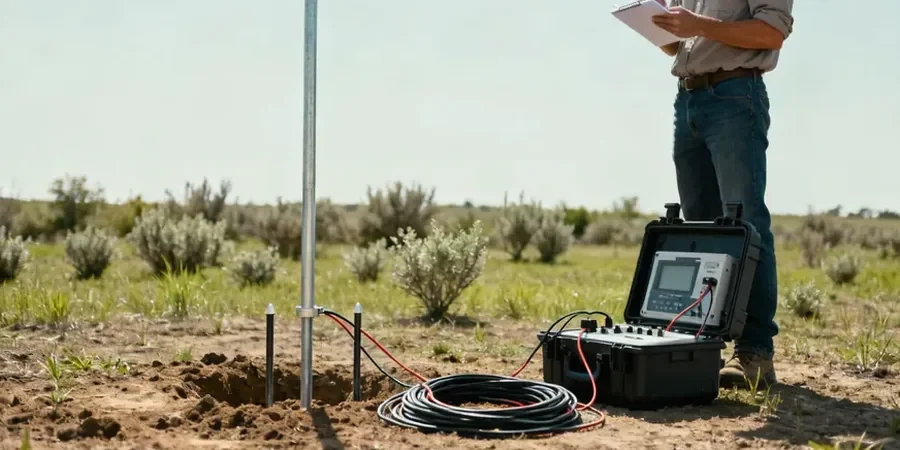
A recent warehouse project off SH-161 hit a surprise: what the preliminary geotech report called 'stiff clay' turned out to be a 12-foot lens of water-bearing sand at 18 feet depth. The contractor lost three days dewatering. We ran a 5-point VES array across the pad and spotted the lens on the second sounding — resistivity jumped from 8 Ωm in the clay to 65 Ωm in the saturated sand. That kind of lateral discontinuity is invisible to a boring spaced every 200 feet. Our field setup uses a Syscal Pro 48-channel unit with stainless steel electrodes and a 12V battery source, recording AB/2 increments of 1.5, 2, 3, 5, 7, 10, 15, 20, 30, 50, 75, 100, 150, 200, and 300 feet. Each sounding takes roughly 45 minutes on site. The raw data undergoes 1D inversion using IPI2Win software with an RMS error threshold below 5%, and we deliver interpreted layer models showing thickness and resistivity for each geoelectric unit.
Electrical Resistivity Testing (VES) for Site Investigation in Irving
Technical reference — Irving

Site-specific factors

Irving's summer heat is brutal on resistivity surveys. Surface soils dry out to a hard crust by July, and contact resistance at the electrodes can spike above 50 kΩ if you don't prep the ground. We carry saline solution and pre-wet each electrode position when the top 6 inches are baked. Worse is the urban noise along SH-114 and Belt Line Road — ground currents from power lines and cathodic protection systems on gas pipelines inject 60 Hz noise into the potential dipole. Our Syscal unit applies automatic stacking and notch filtering, but in high-noise corridors we switch to a Wenner array for stronger signal-to-noise ratio. Another risk is misinterpreting a low-resistivity zone as groundwater when it is actually a clay-rich paleosol layer common in the Woodbine Formation. We cross-check every VES profile against at least one calibration boring to anchor the resistivity-to-lithology conversion, following the approach of Keller and Frischknecht (1966) for layered-earth interpretation.

Need a geotechnical assessment?

Reply within 24h.

Email: [email protected]

Reference standards

ASTM D6431-18 — Standard Guide for Using the Direct Current Resistivity Method for Subsurface Site Characterization, IBC 2021 — Section 1803 Geotechnical Investigations, ASCE 7-22 — Chapter 20 Site Classification Procedure for Seismic Design

Technical parameters

ParameterTypical value
Array configurationSchlumberger (standard); Wenner available for lateral profiling
Maximum AB/2 spacing300 ft (effective investigation depth ~90 ft)
Typical resistivity range measured2–200 Ωm in Irving soils; up to 500 Ωm in dry sand
Data acquisition unitSyscal Pro 48-channel, 250W transmitter
Inversion software and RMS targetIPI2Win 1D; RMS error <5%
Electrode typeStainless steel, 18-inch spike
Reporting standardASTM D6431-18

Common questions

How much does a VES survey cost for a typical lot in Irving?

For a standard 5-point VES survey on a residential or light commercial lot within Irving, the cost ranges from US$670 to US$1,010 depending on access conditions and maximum AB/2 spacing required. The price includes field acquisition, 1D inversion, and a signed report with interpreted geoelectric cross-sections. Larger sites requiring 2D ERT profiles are quoted separately after a site walk.

What depth can a VES survey reach in the soils around Irving?

With a maximum AB/2 spacing of 300 feet, we achieve an effective investigation depth of roughly 90 to 100 feet in Irving's typical soil profile. That is sufficient to penetrate through the Quaternary alluvium, the Eagle Ford Shale weathered zone, and into competent bedrock. Deeper penetration requires larger spreads, but urban site constraints along the Trinity River corridor usually limit us to 300-foot AB/2.

Can resistivity testing distinguish between expansive clay and stable clay in Irving?

Not directly — expansive and non-expansive clays can have overlapping resistivity ranges between 5 and 15 Ωm. What VES does well is map the thickness and lateral continuity of the clay unit. We correlate the resistivity profile with Atterberg limits and swell test results from a calibration boring to confirm whether a given low-resistivity layer corresponds to the highly plastic Eagle Ford Shale (PI typically 40–60%) or to a less active silty clay. The geophysical data guides where to sample, but the lab testing provides the definitive classification.

Location and service area

We serve projects in Irving and surrounding areas.

View larger map